





Understanding what are L1 L2 L3 fire alarm systems is important for anyone responsible for fire safety in commercial buildings, residential properties, schools, offices and other premises across the UK. Fire alarm categories define the level of automatic detection coverage provided throughout a building and help determine how quickly a fire can be identified.
The correct fire alarm category depends on the size of the building, its use, occupancy levels, fire risks and the findings of a fire risk assessment. Selecting the wrong system can leave important areas without adequate protection or result in unnecessary costs.
In the UK, fire alarm systems are commonly designed in accordance with BS 5839-1, which provides recommendations for fire detection and fire alarm systems in non domestic premises. The standard categorises systems into different levels, including L1, L2 and L3 systems.
L1 provides the highest level of automatic detection coverage, while L3 provides detection in areas where fire could affect escape routes. L2 sits between these two categories by providing enhanced detection in specific higher risk areas.
Key Takeaways
- L1 systems provide the highest level of detection coverage throughout a building.
- L2 systems protect escape routes and additional high risk areas.
- L3 systems focus on detecting fires that could affect escape routes.
- The correct system depends on the building’s fire risk assessment, layout and occupancy.
- BS 5839-1 provides guidance for fire alarm system design, installation and maintenance.
- Regular testing and servicing are essential to keep fire alarm systems effective.
What Are L1 L2 L3 Fire Alarm Categories?
L1, L2 and L3 are categories of automatic fire detection systems designed to provide different levels of protection.
The “L” classification refers to systems designed primarily for the protection of life. These systems aim to provide early warning to occupants so they can evacuate safely before conditions become dangerous.
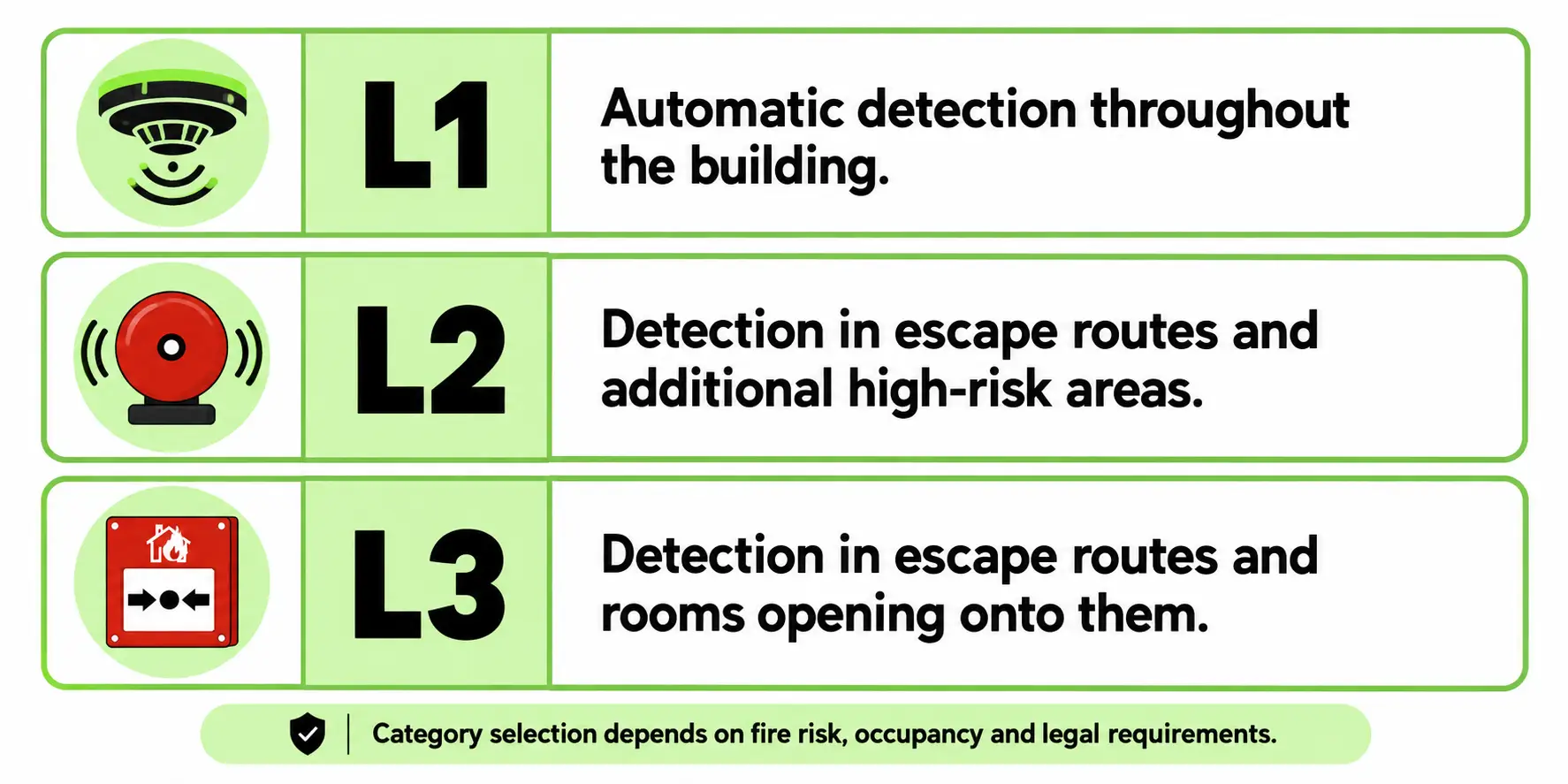
The main difference between L1, L2 and L3 systems is the extent of detection coverage.
An L1 system provides automatic detection throughout almost the entire building.
An L2 system provides detection in escape routes and additional areas where there is a higher likelihood of fire developing.
An L3 system provides detection in escape routes and rooms opening onto those escape routes where fire could prevent safe evacuation.
The appropriate category should be selected based on a fire risk assessment rather than simply choosing the highest level available.
What Is an L1 Fire Alarm System?
An L1 fire alarm system provides the highest level of automatic fire detection coverage for life protection.
In an L1 system, automatic fire detectors are installed throughout all areas of the building, including rooms, corridors, circulation spaces and other locations where a fire could start.
The purpose of an L1 system is to provide the earliest possible warning of fire, giving occupants maximum time to evacuate.
Where Are L1 Fire Alarm Systems Used?
L1 systems are commonly used in buildings where early detection is particularly important due to the occupants, building layout or fire risks.
Examples may include:
- Residential care homes
- Hospitals
- Large residential buildings
- Buildings containing vulnerable occupants
- Complex premises with sleeping accommodation
The exact requirement depends on the fire risk assessment and the recommendations of a competent fire safety professional.
Advantages of an L1 Fire Alarm System
The main advantage of an L1 system is maximum detection coverage.
Because detectors are installed throughout the building, a fire is more likely to be discovered at an early stage regardless of where it begins.
Benefits include:
- Earlier warning for occupants
- Improved evacuation time
- Greater protection for vulnerable people
- Reduced risk of fire developing unnoticed
However, because an L1 system requires more detectors, installation and maintenance costs are usually higher compared with lower category systems.
What Is an L2 Fire Alarm System?
An L2 fire alarm system provides automatic detection in escape routes and additional areas where there is a higher risk of fire.
It offers more protection than an L3 system but less coverage than an L1 system.
An L2 system is designed to detect fires early in areas where a fire could start and spread towards escape routes before occupants have evacuated.
What Areas Are Covered by an L2 Fire Alarm System?
An L2 system includes automatic detection in:
- Escape routes
- Rooms opening onto escape routes
- Specific high risk areas identified by the fire risk assessment
Additional detection may be required in areas such as:
- Kitchens
- Boiler rooms
- Electrical rooms
- Storage areas
- Workshops
The exact locations depend on the hazards present within the building.
Where Are L2 Fire Alarm Systems Used?
L2 systems are commonly installed in buildings where enhanced protection is required but full coverage may not be necessary.
Typical examples include:
- Offices
- Hotels
- Schools
- Commercial premises
- Buildings with sleeping accommodation
For example, a hotel may require detection in bedrooms, corridors and higher risk areas to provide early warning before a fire affects escape routes.
Advantages of an L2 Fire Alarm System
An L2 system provides a balance between protection and cost.
It offers:
- Early detection in important areas
- Protection of escape routes
- Additional coverage for higher risk locations
- Improved occupant safety compared with lower category systems
The system is often selected where a fire risk assessment identifies specific areas that require additional protection.
What Is an L3 Fire Alarm System?
An L3 fire alarm system provides automatic detection to protect escape routes and areas that open directly onto those escape routes.
The purpose of an L3 system is to ensure that occupants receive sufficient warning before a fire blocks their means of escape.
Unlike L1 systems, an L3 system does not provide automatic detection throughout the entire building.
What Areas Are Covered by an L3 Fire Alarm System?
An L3 system normally includes detectors in:
- Escape corridors
- Escape stairways
- Rooms opening onto escape routes
The aim is to identify a fire before it develops to a stage where people cannot safely leave the building.
For example, if a fire starts in an office opening onto a corridor, the detector should activate before smoke prevents people from using that corridor as an escape route.
Where Are L3 Fire Alarm Systems Used?
L3 systems are commonly used in smaller commercial premises and buildings where the main objective is protecting escape routes.
Examples may include:
- Small offices
- Shops
- Smaller commercial buildings
- Some residential premises
The suitability of an L3 system depends on the building design, occupancy and fire risk assessment.
Advantages of an L3 Fire Alarm System
An L3 system provides important life safety protection by focusing detection where it can help occupants escape.
Benefits include:
- Early warning along escape routes
- Protection against smoke blocking exits
- Suitable protection for many lower risk buildings
- Lower installation cost compared with full coverage systems
However, because detection coverage is limited, a fire developing away from escape routes may not be detected as quickly as with an L1 or L2 system.
Difference Between L1 L2 and L3 Fire Alarm Systems
The main difference between L1, L2 and L3 fire alarm systems is the amount of automatic detection coverage provided.
L1 vs L2 Fire Alarm System
The difference between L1 and L2 systems is that L1 provides detection throughout the building, while L2 provides detection only in specified areas, including escape routes and higher risk locations.
L1 offers the greatest level of coverage but requires more equipment and maintenance.
L2 provides targeted protection where fire risks are considered higher.
L2 vs L3 Fire Alarm System
The difference between L2 and L3 systems is the additional detection coverage included in an L2 system.
An L3 system focuses mainly on protecting escape routes.
An L2 system adds detectors in areas where fire is more likely to start or where a fire could quickly affect escape routes.
How Is the Correct Fire Alarm Category Selected?
The correct fire alarm category should be determined through a suitable fire risk assessment.
Factors considered include:
- Building size and layout
- Number of occupants
- Sleeping accommodation
- Vulnerable occupants
- Fire hazards present
- Escape route design
- Building use
- Existing fire protection measures
A competent fire safety professional can recommend the appropriate category based on the risks identified.
Choosing a fire alarm system should not be based only on building size. Two buildings of similar size may require different systems because their risks and occupancy arrangements can be completely different.
What Standards Cover L1 L2 L3 Fire Alarm Systems?
Fire alarm system categories in the UK are mainly covered by BS 5839-1, which provides recommendations for the design, installation, commissioning and maintenance of fire detection and fire alarm systems in non domestic premises.
The standard provides guidance on system categories, detector placement, alarm arrangements and maintenance requirements.
Fire alarm systems should also be maintained regularly to ensure detectors, control panels, sounders and manual call points continue operating correctly.

How Often Should Fire Alarm Systems Be Tested?
Fire alarm systems should be tested regularly to confirm they remain effective.
Routine checks typically include:
- Weekly testing of manual call points on a planned rotation
- Regular inspection and servicing by a competent person
- Testing of detectors, alarms and control equipment
- Recording results in the fire alarm logbook
The exact testing requirements depend on the system type, building use and relevant guidance.
Frequently Asked Questions
What does L1 mean on a fire alarm system?
An L1 fire alarm system provides automatic fire detection throughout almost the entire building, offering the highest level of life protection.
What does L2 mean on a fire alarm system?
An L2 fire alarm system provides detection in escape routes and additional areas where there is a higher risk of fire developing.
What does L3 mean on a fire alarm system?
An L3 fire alarm system provides detection in escape routes and rooms that open onto those routes to help occupants evacuate safely.
Which fire alarm system is best, L1 L2 or L3?
The correct system depends on the building’s risks, occupancy and fire risk assessment. The highest category is not always required for every building.
Is an L3 fire alarm system enough for an office?
An L3 system may be suitable for some offices, but the correct category depends on the office layout, occupancy and fire risk assessment.
Conclusion
Understanding what are L1 L2 L3 fire alarm systems helps building owners, employers and responsible persons choose the correct level of fire detection protection.
An L1 fire alarm system provides automatic detection throughout the building and offers the highest level of life protection. An L2 system provides enhanced detection in escape routes and higher risk areas, while an L3 system focuses on protecting escape routes and rooms that could affect evacuation.
The correct fire alarm category should always be based on a suitable fire risk assessment and the specific needs of the building. Proper design, installation, testing and maintenance ensure that fire alarm systems continue to provide reliable warning when it is needed most.