



The Level 3 Certificate in Fire Risk Assessment trains candidates to identify hazards, assess risks and recommend mitigation for commercial and public buildings. It covers fire science, legal standards, inspection techniques, report writing and human factors, with workplace-based practical assessments and portfolio evidence. Delivery varies across classroom, blended, and online formats and includes external moderation for credibility. Graduates can work in-house or as consultants and access CPD and progression options; continue for detailed guidance on courses, costs and career paths.
Key Takeaways
- The Level 3 Certificate equips candidates to perform competent fire risk assessments for buildings and to progress into safety manager or consultant roles.
- The course covers fire science, legal duties, evacuation planning, report writing, and fire safety management systems.
- Practical training requires supervised real-world assessments, portfolios, and demonstrated competence in hazard identification.
- Assessment combines written exams, practical tasks, portfolio evidence, and external moderation for credibility.
- Choose accredited providers with experienced tutors, flexible delivery, post-course support, and transparent fees and resit policies.
Who Should Take the Level 3 Fire Risk Assessment Certificate
Who, precisely, should pursue the Level 3 Fire Risk Assessment Certificate? The certificate suits professionals seeking autonomy in safety decision-making: building managers, facilities supervisors, health and safety officers, and consultants aiming to expand credentials. It also suits tradespeople and engineers who want to integrate fire-risk competency into independent practice, enabling clearer contracts and better liability control. Small business owners responsible for premises safety find it empowering,, and it reduces reliance on external advisors.
Those undertaking a Level 3 Fire Risk Assessment Certificate should understand that fire risk assessment responsibilities in the UK are governed by the Regulatory Reform (Fire Safety) Order 2005 (FSO). The legislation places duties on the Responsible Person to identify fire risks, implement suitable control measures, and maintain fire safety arrangements within non domestic premises. While the law does not require a specific qualification for all individuals carrying out fire risk assessments, it requires that anyone appointed must have sufficient competence, knowledge, and experience to complete assessments effectively. A Level 3 qualification helps demonstrate this competence and supports professionals in meeting the expectations of the FSO when providing fire risk assessment services.
Those moving from operational roles into compliance or advisory positions gain structured recognition that supports career mobility and freelance opportunities. Candidates motivated by regulatory clarity, practical application, and the ability to act decisively in varied environments will benefit most. Prior experience in building systems, maintenance, or basic fire safety is useful but not mandatory; willingness to assume responsibility and interpret guidance toward pragmatic solutions matters more. The course therefore appeals to individuals valuing capability, responsibility, and professional freedom.

Level 3 Course Syllabus: Modules and Core Skills Taught
Building on the target audience and responsibilities outlined previously, the Level 3 Fire Risk Assessment course syllabus is organised into focused modules that build practical assessment skills, legislative knowledge, and report-writing competence. The curriculum typically includes fire science fundamentals, covering ignition sources, fire development, smoke behaviour, and fire dynamics to enable clear-minded hazard evaluation.
Legal and regulatory modules explain duties under applicable fire safety law, standards, and guidance, empowering autonomous compliance decisions. Practical risk assessment workshops train participants in systematic inspection techniques, the identification of passive and active fire protection measures, and the prioritisation of remedial actions. Report-writing and communication units teach concise documentation, clear recommendations, and stakeholder engagement to support independent implementation.
Additional modules cover human factors, evacuation planning, and simple fire safety management systems, promoting adaptable strategies across premises. Throughout, scenario-based exercises and case studies reinforce transferable skills, enabling practitioners to conduct robust assessments, recommend proportionate controls, and operate with the freedom to apply professional judgement.
Assessment and Certification for the Level 3 Qualification
Assessment and certification for the Level 3 qualification combine formal examinations, practical evaluations, and portfolio evidence to validate competence. The process balances objective testing with demonstrable application, enabling candidates to claim professional freedom through recognised credentials. Assessors measure understanding of legislation, risk analysis, and mitigation planning; portfolios document real-world judgments and reflective learning. Certification follows successful completion of set criteria and moderated assessment outcomes, granting mobility within fire safety roles and confidence to act independently.
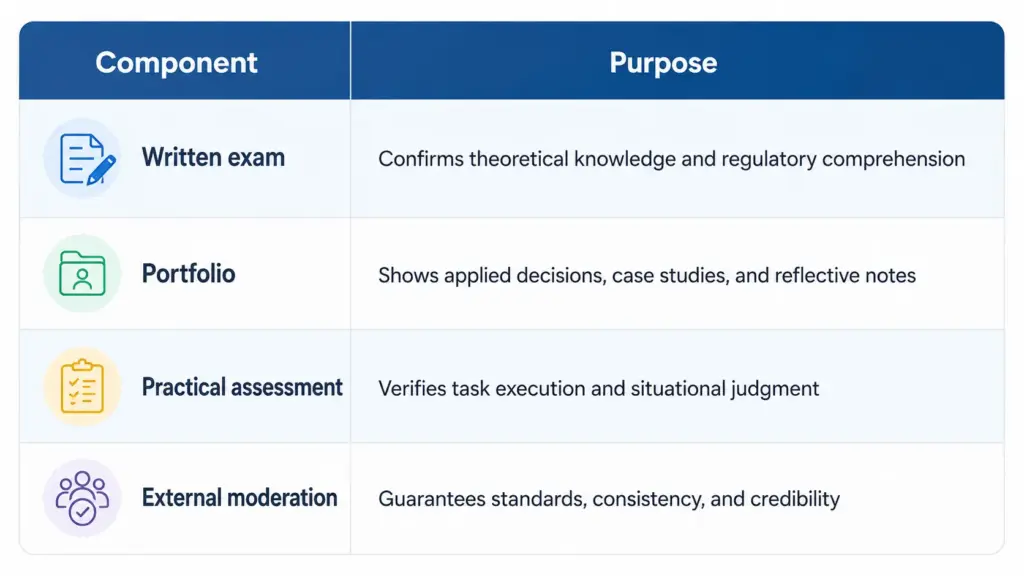
Certification bodies issue a formal certificate and record results on national registers where applicable. Candidates are advised to maintain CPD and update portfolios to preserve autonomy and credibility in evolving practice.
Practical Training and Workplace-Based Assessment: What to Expect
Following certification, practical training and workplace-based assessment consolidate knowledge into routine practice by placing candidates in supervised, real-world settings where skills are observed and recorded. Trainees conduct supervised fire risk assessments, apply control measures, and prepare clear reports under the guidance of experienced assessors. Evidence requirements focus on demonstrated competence: accurate hazard identification, proportionate recommendations, and effective communication with stakeholders. Workplace assessors collect observation records, witness testimonies, and candidate-produced documentation to verify performance.
Assessments are competency-based and flexible, allowing candidates to progress at a practical pace while retaining autonomy over task execution. Feedback is structured, actionable, and tied to specific standards; remedial coaching targets precise gaps. Health and safety compliance, professional conduct, and ethical decision-making are monitored throughout. Successful workplace-based assessment results in documented evidence for certification bodies, while incomplete elements prompt targeted reassessment. The process emphasises practical independence, ensuring candidates can execute fire risk duties reliably and confidently within varied work environments.
Entry Requirements, Course Length, Delivery Formats and Typical Timelines
Typically, candidates must meet basic educational and occupational prerequisites such as a minimum level of literacy and numeracy, relevant workplace experience, or employer nomination before enrolling. Entry standards are modest to allow motivated individuals to gain skills and autonomy. Courses suit those seeking flexible progression: full-time learners finish faster, while working professionals balance modular study with shifts.
Delivery varies: classroom-led, blended learning, and fully online options each offer different rhythms and independence. Course length typically ranges from a few days of intensive study to several weeks of part-time study, with assessment windows slightly extending the timeline. Timelines depend on provider scheduling, assessment submission, and required workplace evidence, but typical completion spans 1–12 weeks.
| Format | Typical Length | Feelings Evoked |
| Intensive classroom | 2–5 days | Empowered, decisive |
| Blended | 2–6 weeks | Balanced, hopeful |
| Fully online | 1–12 weeks | Liberated, self-directed |
Career Outcomes: Job Roles, Employer Uses, In-House vs Consultant Routes
After completing the course, candidates can apply their skills across a range of roles from in-house safety officers to independent consultants, with employers valuing the ability to identify hazards, quantify risk, and recommend mitigation measures. Graduates often move into roles such as fire risk assessor, premises safety manager, compliance officer, or facilities risk coordinator. In-house positions suit those who prefer stability and direct influence over one organisation’s safety culture; responsibilities typically include conducting regular inspections, developing policies, training staff, and liaising with regulators.
The consultant route appeals to individuals seeking autonomy, varied assignments, and the opportunity to build a client base across sectors such as commercial, healthcare, education, and residential. Employers use certificate holders to meet legal duties, streamline insurance requirements, and reduce incident-related costs. Market demand favours practical report writing, consistent inspections, and clear remedial actions. Career mobility exists between paths; in-house experience can segue into consultancy, and vice versa, allowing professionals to shape a work pattern aligned with personal freedom and professional goals.
Cost, CPD and Progression After Level 3
Costs for Level 3 fire risk assessment courses vary by provider and format, with classroom courses usually priced higher than blended or fully online options; fees commonly range from modest employer-subsidised rates to several hundred pounds or dollars for accredited programmes. The candidate considers cost alongside flexible delivery, recognising that lower-cost online routes can free time for other pursuits while classroom study may offer networking and hands-on practice. Continuing Professional Development (CPD) maintains competence: short workshops, webinars, and reflective logs keep knowledge current and portable for those valuing autonomy. Progression after Level 3 often leads to specialist CPD modules, supervisory roles, or a shift into consultancy, with additional qualifications and experience. Career paths remain adaptable, enabling movement between in-house safety teams and freelance work.
| CPD Options | Progression Routes |
| Workshops | Senior assessor |
| Webinars | Specialist modules |
How to Choose a Reputable Training Provider (What to Compare)
Having considered cost, delivery format and CPD when planning progression, the next step is to compare training providers on a set of objective criteria. Prospective learners should assess accreditation status, ensuring recognised awarding bodies back the certificate. Course content must align with regulatory standards and the practical skills required for independent risk assessment. Tutor qualifications and industry experience indicate quality and real-world relevance. Delivery flexibility: blended, online, or in-person options support autonomy and practical constraints. Class size and resources affect interaction and hands-on practice.
Assessment methods and certification timelines reveal rigor and portability of credentials. Post-course support, mentoring, and access to updated materials enable ongoing competence. Employer links and graduate outcomes demonstrate market recognition. Transparent policies on refunds, resits, and complaints protect learners’ rights. Comparing these factors allows individuals seeking freedom to select a provider that offers credible certification, practical preparation, and the flexibility to pursue an autonomous career in fire risk assessment.
Frequently Asked Questions
Will This Certificate Exempt Me From Local Statutory Fire Safety Duties?
No, it does not automatically exempt one from local statutory fire safety duties. The certificate demonstrates competence, but legal responsibilities depend on jurisdictional law; individuals remain obligated to comply with regulations and employers’ responsibilities unless law specifically states otherwise.
Can International Qualifications Substitute for Level 3 Entry Requirements?
Yes. He may submit international qualifications for consideration; awarding bodies often accept equivalent credentials but require documented evidence, translations, and sometimes bridging modules. Applicants seeking flexibility should contact the course provider to confirm specific entry equivalencies.
Do Employers Require Specific Insurance for Level 3 Assessors?
Yes. Employers often require assessors to hold specific professional indemnity and public liability insurance. The assessor independently secures suitable cover, choosing policies that protect client freedom and personal autonomy while meeting employer or contractual expectations.
Is Refresher Training Mandatory After Certification Expiry?
No 56 refresher training is not universally mandatory after a certificate expires; requirements vary by employer, regulator, and insurer. The individual should check relevant rules, maintain competence voluntarily, and seek refresher courses to preserve freedom and mobility.
Are There Specialist Modules for High-Rise or Historic Buildings?
Yes, specialist modules exist for high-rise and historic buildings. The learner can choose targeted units addressing structural complexity, evacuation challenges, heritage conservation constraints, and bespoke fire safety strategies, enabling autonomy in skill development and professional focus.
Conclusion
The Level 3 Certificate in Fire Risk Assessment equips practitioners with the knowledge and practical skills needed to identify fire hazards, evaluate risks and recommend proportionate control measures. Suited to facilities, safety officers and aspiring consultants, it combines classroom learning, workplace assessment and formal evaluation. Completion enhances employability across in-house and consultancy roles, supports continuing professional development and provides a clear stepping stone to higher qualifications and specialist fire safety careers.