



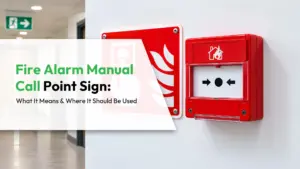


A fire alarm manual call point sign is used to identify the location of a manual call point, allowing a person who discovers a fire to quickly find the equipment and raise the alarm. Manual call points are an important part of many fire detection and alarm systems because they allow people to activate the alarm manually rather than waiting for an automatic detector to respond.
A manual call point is commonly recognised as a red device, traditionally referred to as a break glass call point. The associated sign should be clear, visible and easily understood so that occupants can identify the equipment during an emergency. The Fire Industry Association states that building occupants need to be able to identify and locate fire alarm call points and that suitable fire safety notices can support effective fire safety management.
The appearance and positioning of the sign should be considered alongside the location of the manual call point itself. A call point that is hidden behind furniture, poorly illuminated or difficult to distinguish from surrounding equipment may delay alarm activation. Government fire safety guidance recommends that manual call points are conspicuous, red and positioned where they can be readily accessed.
Key Takeaways
- A fire alarm manual call point sign identifies the location of a manual call point.
- Manual call points allow people to raise the fire alarm manually when they discover a fire.
- The call point should be conspicuous, accessible and easy to recognise.
- Red is the recognised colour associated with fire alarm and firefighting equipment.
- Signage should not be hidden, obstructed or difficult to see.
- Manual call points are commonly positioned at exits and storey exits.
- Government guidance generally refers to a maximum travel distance of 45 metres to the nearest manual call point, subject to the circumstances of the premises.
- The current non-domestic fire alarm code of practice is BS 5839-1:2025.
What Is a Fire Alarm Manual Call Point Sign?
A fire alarm manual call point sign is a safety sign that indicates where a person can manually activate the building’s fire alarm. The sign normally uses a fire safety symbol that is immediately recognisable rather than relying entirely on written words. A commonly used fire alarm call point sign has a red background with a white graphical symbol representing the operation of the alarm. The Fire Industry Association‘s guidance on fire safety signs illustrates the fire alarm call point sign alongside other fire safety notices and equipment signs.
The purpose of the sign is simple: if someone discovers smoke or fire, they should not have to search around the building to find a device capable of raising the alarm. Good fire safety signage supports rapid recognition. This becomes particularly important in larger premises, areas with multiple fixtures and fittings, locations with poor visibility or buildings used by visitors who may be unfamiliar with the layout.
What Is a Manual Call Point?
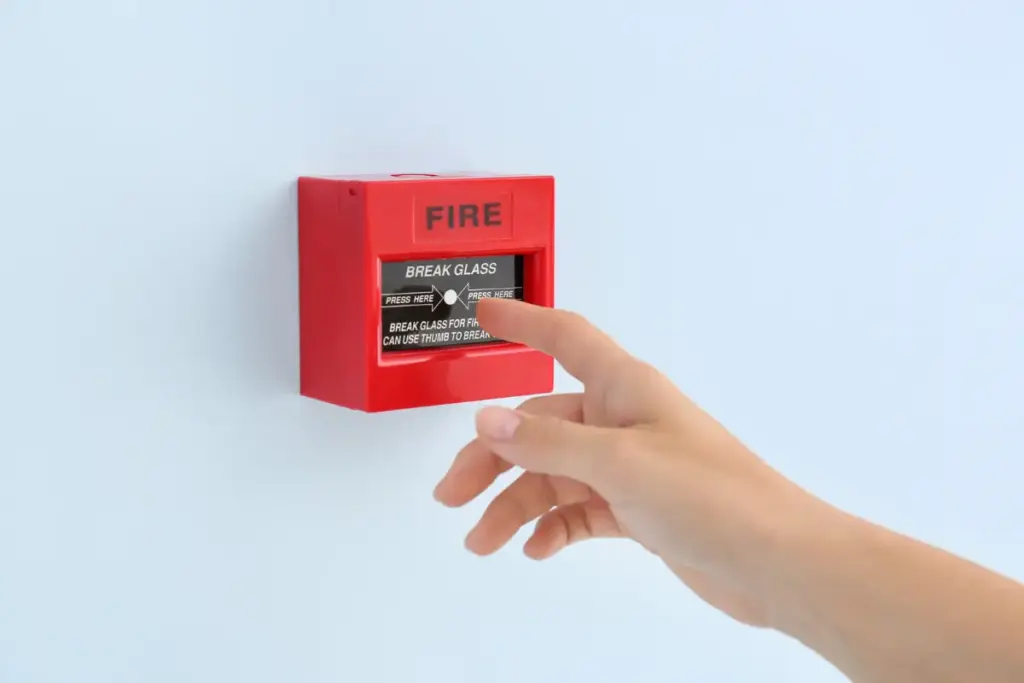
A manual call point is a device that allows a person to activate a fire alarm manually. For example, if someone sees flames before an automatic smoke detector has operated, they can use the manual call point to raise the alarm and warn other occupants.
Manual call points are often described as break glass call points because traditional designs used a frangible glass element. Modern products may use resettable or other operating mechanisms, while protective covers are also commonly used to reduce accidental activation. Government fire safety guidance describes manual call points as devices that enable someone who discovers a fire to immediately raise the alarm and warn other people in the premises.
What Does a Fire Alarm Call Point Sign Look Like?
The sign is normally based around the recognised fire safety colour and graphical symbol associated with fire alarm equipment. A red sign is commonly used because red is associated with fire-fighting equipment and fire alarm information. The Health and Safety guidance on safety signs explains that fire safety signs are used to provide information concerning fire, including the identification and location of firefighting equipment and warnings in the event of fire.
The graphical symbol should be sufficiently clear for occupants to understand its purpose without having to read a long explanation. Where appropriate, supplementary wording such as Fire Alarm Call Point or Fire Alarm can be used to reinforce the meaning of the symbol, particularly where the building is complex or where additional clarity is beneficial.
Why Is a Manual Call Point Sign Important?
The purpose of a manual call point is to provide a quick way of raising the alarm. If occupants cannot identify the call point, its benefit can be reduced. Imagine a person discovering a fire in a corridor. They may know that the building has a fire alarm but may not immediately know where the nearest manual call point is located. A clear sign can direct their attention towards the equipment and reduce the time needed to find it.
This is particularly important for visitors, contractors and members of the public who may not know the building. Employees should receive fire safety information and training, but visitors cannot always be expected to understand the premises in the same way as regular occupants. The Fire Industry Association specifically notes the importance of enabling occupants to identify and locate manual call points.
Where Should a Fire Alarm Manual Call Point Sign Be Placed?
The sign should be positioned so that it clearly identifies the manual call point and can be seen from an appropriate approach to the equipment. It should not be hidden behind doors, furniture, storage, decorations or other building features. The sign and call point should remain visible and accessible during normal use of the premises.
The precise position of the sign depends on the physical arrangement of the building. In a straightforward corridor, the sign may be positioned directly above or immediately adjacent to the manual call point. In a more complicated environment, additional directional signage may be appropriate if the call point cannot be readily seen from the relevant approach. The Health and Safety Executive’s guidance on safety signs states that signs should be clear and legible and should be used to direct people towards fire exits and equipment where required.
Where Should Manual Call Points Be Located?
The location of the manual call point itself is more important than simply putting up a sign. Government guidance for offices and shops states that manual call points are normally positioned at exits and storey exits that people may reasonably be expected to use in the event of fire. It also states that, after fixtures, fittings, machinery and stock have been taken into account, people should normally not have to travel more than 45 metres to reach the nearest alarm point. This distance may need to be reduced where premises accommodate people with limited mobility or where particularly hazardous conditions exist.
The exact arrangement should be determined as part of the fire alarm system design rather than applying the 45 metre figure without considering the building’s circumstances.
Should Manual Call Points Be Red?
Manual call points are normally red and should be visually distinguishable. Government fire safety guidance for offices and shops states that manual call points should be conspicuous and red.
The use of red helps occupants distinguish fire alarm equipment from other controls, switches and building services. A manual call point that has been painted over, obscured or surrounded by visually similar equipment can become difficult to identify. This is why maintaining the visibility of the device and its associated signage is an important part of fire alarm management.
How High Should a Manual Call Point Be?
Government guidance for offices and shops states that manual call points should be fitted at a height of approximately 1.4 metres, with a lower height considered where premises have a significant number of wheelchair users. This refers to the positioning of the manual call point rather than establishing a universal mounting height for every associated sign.
The sign should be positioned so that it can be easily seen and understood while approaching the call point. It should not be mounted so high, low or remotely that occupants cannot easily associate it with the device. Accessibility should also be considered when determining the final arrangement.
Is a Fire Alarm Manual Call Point Sign Legally Required?
The answer depends on the premises, the circumstances and the requirements of the applicable fire safety arrangements. The Health and Safety (Safety Signs and Signals) Regulations 1996 establish requirements for safety signs in workplaces where signs are necessary to communicate health and safety information. HSE guidance explains that signs should be clear and legible and can be used to identify and direct people towards fire exits and equipment.
It would therefore be too simplistic to state that every manual call point in every type of building must have an identical separate sign mounted above it. Instead, the need for signage should be considered as part of the overall fire safety arrangements, taking account of whether the equipment is clearly identifiable and whether people can locate it quickly. The Fire Industry Association’s guidance also emphasises the importance of occupants being able to identify and locate manual call points.
What Standard Applies to Manual Call Points?
For non-domestic premises, BS 5839-1:2025 is the current code of practice covering the design, installation, commissioning and maintenance of fire detection and fire alarm systems. The 2025 edition was published on 30 April 2025. The standard covers many aspects of fire alarm system design, including manual call points, detection zones, alarm devices, control equipment, installation and maintenance.
BS 5839-1 should not be treated as legislation itself. It is a code of practice containing technical recommendations for fire detection and alarm systems in non-domestic premises. The applicable fire safety legislation and the building’s fire risk assessment also need to be considered.
Do Manual Call Points Need Protective Covers?
Protective covers are commonly used on manual call points to reduce accidental or malicious activation. The recommendation for protective covers was introduced in BS 5839-1:2017 for new systems and extensions. FIA guidance explains that existing call points installed before that change do not automatically need to be retrofitted with covers simply because the recommendation was introduced.
The 2025 edition has also made changes relating to manual call points and protective covers. FIA’s guidance on BS 5839-1:2025 states that protective covers introduced as a recommendation in the 2017 edition are now recommended to be transparent. A cover should not prevent someone from quickly operating the alarm when there is a genuine fire. It should also allow the call point’s status and operating mechanism to remain suitably visible.
Why Are Manual Call Point Covers Used?
One reason for using a protective cover is to reduce accidental activation. Manual call points can be vulnerable to accidental impact from people, trolleys, equipment, hospital beds, forklifts and other objects. The Fire Industry Association has identified these types of impacts as potential causes of unwanted activation.
A protective cover can provide a physical barrier while still allowing the device to be operated when required. The cover should be compatible with the particular call point and should not interfere with testing, maintenance, visual indication or operation.
Should the Fire Alarm Sign Be Photoluminescent?
Photoluminescent signage can be useful in locations where visibility may be reduced if normal lighting fails. However, the decision should be based on the building’s fire safety arrangements and the visibility requirements of the particular location.
A sign is only useful if occupants can recognise it. If a call point is located in a poorly lit corridor, basement, stairway or other area where visibility could be reduced, additional consideration may be necessary. Emergency lighting should also be considered separately because signage does not replace adequate emergency illumination.
Can a Manual Call Point Be Hidden Behind a Door?
A manual call point should not be positioned where it is difficult to access or identify. Government guidance recommends that manual call points are conspicuous and not located in areas likely to be obstructed.
If a door, cupboard, display, stock or other obstruction prevents people from seeing or reaching the call point easily, the arrangement should be reviewed. The same principle applies to the sign. A clearly designed sign provides little benefit if it is hidden behind another object.
Should There Be a Fire Action Notice Near the Manual Call Point?
A fire action notice and a manual call point sign have different purposes. The manual call point sign identifies the alarm activation device. A fire action notice provides instructions explaining what occupants should do in the event of fire.
Government guidance for people with duties under fire safety legislation states that fire procedure notices are normally needed and that, in buildings with a fire alarm system, a suitable location for such notices is adjacent to the break-glass fire alarm call point. Placing a fire action notice close to a call point can therefore provide useful information at the location where someone may first raise the alarm.
What Information Should a Fire Action Notice Include?
A fire action notice should give clear instructions appropriate to the building’s evacuation arrangements. Depending on the premises, this may include instructions to raise the alarm, call the fire and rescue service, leave the building using the nearest safe route, go to the assembly point and avoid re-entering the building.
The information should correspond with the actual fire safety procedures for the premises. A generic notice should not contradict the building’s evacuation strategy. This is particularly important in complex buildings where different evacuation procedures may apply.
Manual Call Point Signs in Commercial Buildings
In offices, shops, warehouses, workshops and other commercial premises, manual call point signs should form part of the overall fire safety arrangements. Employees should know where manual call points are located and how to operate them. Visitors should also be able to identify fire safety equipment without needing specialist knowledge.
The Fire Industry Association advises that fire detectors and manual call points are frontline elements of fire safety and that call points should be positioned so that they cannot easily be knocked accidentally. The surrounding area should therefore be kept clear and the equipment should remain readily accessible.
Manual Call Point Signs in HMOs and Residential Buildings
Manual call points can also form part of fire alarm systems in houses in multiple occupation and other residential buildings where the fire strategy requires them. The exact fire alarm arrangement depends on the type of property, its layout, occupancy and applicable fire safety requirements.
Where manual call points are installed, occupants need to be able to identify and access them. The associated signage should therefore be considered as part of the overall fire alarm and fire safety design. Residential premises should not simply adopt a commercial fire alarm arrangement without considering the requirements applicable to the specific building.
Manual Call Point Signs in Schools
Schools have particular considerations because they may contain children, staff, visitors and people with different levels of understanding of emergency procedures. Manual call points should be easy to identify and accessible to the people who may need to operate them.
Staff should understand how the fire alarm system operates and what action is expected when an alarm is raised. The placement of fire alarm signs and fire action notices should support the school’s emergency procedures rather than creating conflicting instructions.
What Should Be Checked During a Fire Alarm Inspection?
During routine inspection and maintenance, the condition and accessibility of manual call points should be considered. The device should remain visible, accessible and free from obstruction. The associated sign should also remain legible and securely positioned.
The call point itself should be checked for damage and signs of accidental activation. Where protective covers are installed, they should be inspected to ensure that they can be opened and that they do not prevent the device from being operated or tested.
Government guidance for offices and shops recommends weekly testing of fire-warning systems, with manual call points activated using a suitable test key and different call points used for successive weekly tests. It also states that testing and maintenance should be undertaken by a competent person.
What If the Manual Call Point Sign Is Missing?
A missing sign should not automatically be treated as proof that the entire fire alarm system is unsafe, but it should be considered as part of the overall fire safety assessment. The key questions are whether occupants can clearly identify the manual call point, whether it is conspicuous and accessible, and whether additional signage is needed to make its location clear.
If the call point itself is difficult to identify, adding suitable signage may be an appropriate corrective action. If the call point is obstructed, damaged or incorrectly positioned, the underlying issue should also be addressed rather than simply adding a sign.
What If a Manual Call Point Has Been Painted Over?
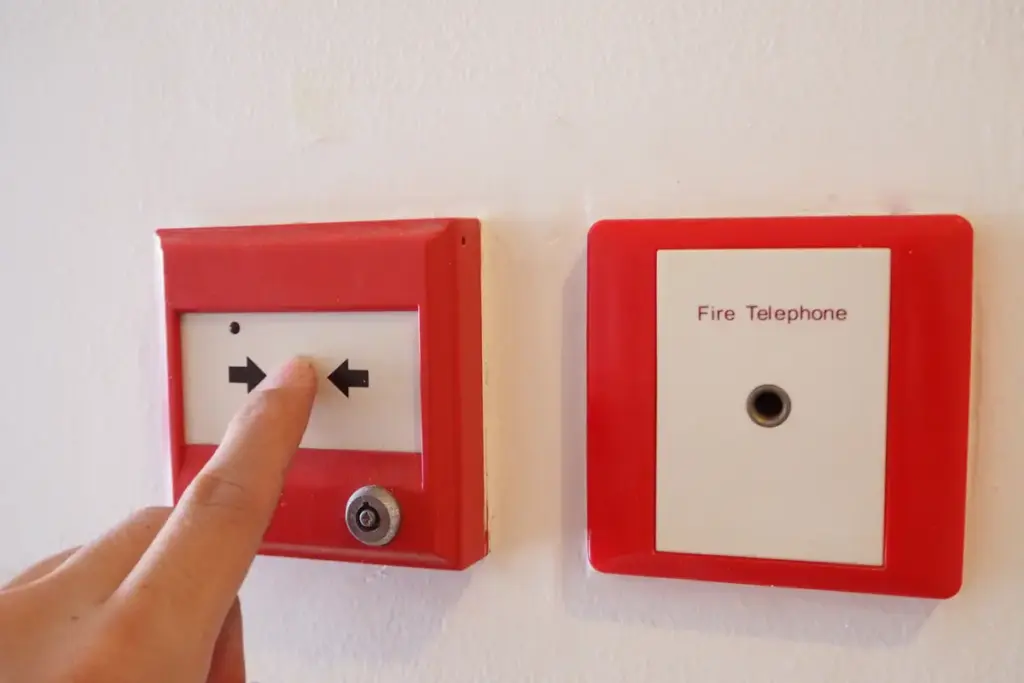
Painting over a manual call point can make it difficult to identify and may interfere with its operation or visual indication. Fire alarm equipment should remain distinguishable from surrounding finishes. If a call point has been painted, covered or otherwise altered, it should be assessed and restored to a suitable condition.
The associated sign should also remain clear and legible. Fire alarm equipment should not be treated as ordinary building decoration. Any changes to the system should be considered in relation to its design and maintenance requirements.
Can You Put Other Signs Next to a Manual Call Point?
Other fire safety information can be located near a manual call point where appropriate, particularly a fire action notice. However, excessive signage can create visual clutter and make individual signs harder to understand. HSE guidance advises avoiding too many signs because they can cause confusion.
The aim should be clear communication rather than simply increasing the number of signs. A manual call point should remain visually distinguishable from nearby notices, switches, controls and other equipment.
Common Problems With Fire Alarm Manual Call Point Signs
One common problem is obstruction. Furniture, stock, displays or temporary equipment may be placed in front of a call point, making it difficult to locate or operate. Another problem is deterioration. A sign can become faded, damaged or dirty over time, particularly in workshops, warehouses, kitchens and external or semi-external environments.
Incorrect positioning can also reduce effectiveness. A sign that is hidden behind a door or mounted where it cannot easily be associated with the call point may not provide useful information. The solution is not always simply to replace the sign. The location, accessibility and visibility of the entire manual call point arrangement should be reviewed.
Why Regular Fire Alarm Maintenance Matters
A sign alone cannot make a fire alarm system effective. The manual call point, wiring, control panel, sounders, power supply and other components all need to remain functional. Regular testing and professional maintenance help identify defects before the system is needed during a real emergency.
The responsible person should ensure that the fire alarm system is maintained appropriately and that defects are investigated and corrected. For non-domestic premises, BS 5839-1:2025 provides the current code of practice for the design, installation, commissioning and maintenance of fire detection and fire alarm systems.
Frequently Asked Questions
What is a fire alarm manual call point sign?
It is a fire safety sign used to identify the location of a manual call point, allowing people to quickly find the device and activate the fire alarm if they discover a fire.
What colour is a manual call point sign?
Manual call point signs are commonly red because red is associated with fire alarm and firefighting equipment.
What does a manual call point do?
A manual call point allows a person to activate the fire alarm manually when they discover a fire.
Where should a manual call point be located?
Manual call points are normally positioned at exits and storey exits that people may reasonably use during an evacuation. Government guidance generally recommends that people should not have to travel more than 45 metres to the nearest alarm point, although this may need to be reduced in certain circumstances.
How high should a manual call point be mounted?
Government guidance for offices and shops refers to approximately 1.4 metres, with a lower height considered where there are significant numbers of wheelchair users.
Does every manual call point need a sign?
The need for signage depends on the premises and whether the equipment can be clearly identified and located. Fire safety signs should be used where necessary to communicate relevant fire safety information and direct people towards fire safety equipment.
Are manual call point signs legally required?
There is not a simple rule that every manual call point in every building must have an identical separate sign. The need for effective identification and signage should be considered within the building’s fire safety arrangements and applicable safety sign requirements.
What standard applies to manual call points?
For non-domestic premises, BS 5839-1:2025 is the current code of practice covering fire detection and fire alarm systems, including their design, installation, commissioning and maintenance.
Should manual call points have protective covers?
Protective covers are recommended for relevant new systems and extensions, and the 2025 edition of BS 5839-1 includes updated recommendations concerning protective covers. FIA guidance states that the 2025 edition recommends transparent covers.
Why are protective covers fitted to manual call points?
They can help reduce accidental or malicious activation while still allowing the call point to be operated during a genuine fire emergency.
Can a manual call point be obstructed?
It should not be obstructed. Manual call points should remain conspicuous and accessible so that people can find and operate them quickly.
Should a fire action notice be next to a manual call point?
This is a common and useful arrangement. Government guidance states that, in buildings with fire alarm systems, a suitable location for fire procedure notices is adjacent to break-glass fire alarm call points.
How often should manual call points be tested?
Fire alarm systems should be tested and maintained according to the applicable system design, standard and maintenance arrangements. Government guidance for offices and shops recommends weekly testing, using a different manual call point for successive tests. Learn How to Check a Fire Alarm for Safety and Reliability.
What should I do if a manual call point sign is missing?
Check whether the call point is still clearly visible and identifiable. If it is not, suitable signage should be considered. Any obstruction, damage or incorrect positioning should also be addressed rather than relying solely on a replacement sign.
Conclusion
A fire alarm manual call point sign is a simple but important part of fire safety communication. Its purpose is to help people quickly identify and locate the manual call point so that the fire alarm can be raised without unnecessary delay.
Manual call points should be conspicuous, accessible and appropriately positioned, while the associated signage should remain clear, visible and free from obstruction. Government guidance commonly recommends positioning manual call points at exits and storey exits and generally limiting travel distance to the nearest alarm point to 45 metres, subject to the circumstances of the premises.
The sign should be considered as part of the complete fire alarm arrangement rather than as an isolated item. Its position, visibility, design and condition should support the building’s fire safety procedures. For non-domestic premises, BS 5839-1:2025 is the current code of practice for fire detection and alarm systems. The applicable fire safety legislation, risk assessment and specific characteristics of the building should also be considered when determining the appropriate arrangement. Keeping manual call points visible, accessible and clearly identified helps ensure that occupants can act quickly when they discover a fire.