

In the UK, a fire risk assessment is legally required for almost all non‑domestic premises and multi‑occupied residential buildings. The Regulatory Reform (Fire Safety) Order 2005 places a duty on the “responsible person” to identify hazards, assess risks, record findings and take remedial action. Smaller sites need proportionate assessments; larger or complex buildings need detailed plans. Some domestic situations fall under other regimes. The summary below explains responsibilities, exemptions, assessment content, review frequency and when to use a competent assessor.
Key Takeaways
- Yes the Regulatory Reform (Fire Safety) Order 2005 requires fire risk assessments for virtually all non-domestic premises and shared residential areas.
- The “responsible person” (employer, owner, landlord) must ensure assessments are carried out, recorded, and acted upon.
- Domestic single-family homes are generally exempt, but HMOs, purpose-built flats, and converted blocks have specific fire safety obligations.
- Assessments must identify hazards, people at risk, existing controls, and include an action plan with review triggers.
- Reviews should be at least annually or after significant changes, with clear records and evidence of remedial actions retained.
Do You Need a Fire Risk Assessment in the UK? (Quick Answer + Criteria)
Who must have a fire risk assessment in the UK? The requirement applies to virtually all non-domestic premises and any residential buildings with multiple occupancies. This includes offices, shops, factories, common areas of apartment blocks, care homes, and licensed premises.
The quick answer: if people other than the owner use or visit the building, a risk assessment is necessary. Criteria hinge on occupancy type, building use, and potential hazards: the presence of vulnerable occupants, combustible materials, the complexity of means of escape, and processes that increase the likelihood of fire. Smaller premises with minimal risk still need a proportionate assessment; larger or higher-risk sites require detailed, documented plans.
The assessment must identify hazards, evaluate who may be harmed, and implement appropriate measures to reduce risk. It should be reviewed after significant changes, incidents, or periodic intervals. This framework enables responsible autonomy while safeguarding life and property.

Who Is Legally Responsible for a Fire Risk Assessment?
Legal responsibility for a fire risk assessment usually rests with the “responsible person” defined in the Regulatory Reform (Fire Safety) Order 2005: typically the employer, owner, landlord, or anyone with control of the premises (such as a facilities manager). This individual or body must guarantee assessments are carried out, reviewed, and acted upon to reduce risk. Where multiple parties share control, duties can be apportioned, but clarity and cooperation are essential to maintain safety and occupants’ autonomy.
- A business owner commissioning an assessment and implementing measures.
- A landlord guaranteeing communal areas and common systems are safe.
- A facilities manager coordinating contractors and day-to-day checks.
Liability may arise if the responsible person fails to identify hazards, neglects to take remedial action, or ignores review cycles. Practical freedom for occupants depends on the responsible person enabling informed, proportionate measures rather than imposing unnecessary constraints. Records of assessments and actions provide protection and accountability. Read our blog post Understanding the Fire Risk Assessment Regulatory Reform Order 2005 To get compliance tips.
Key Law: Regulatory Reform (Fire Safety) Order 2005 and Guidance
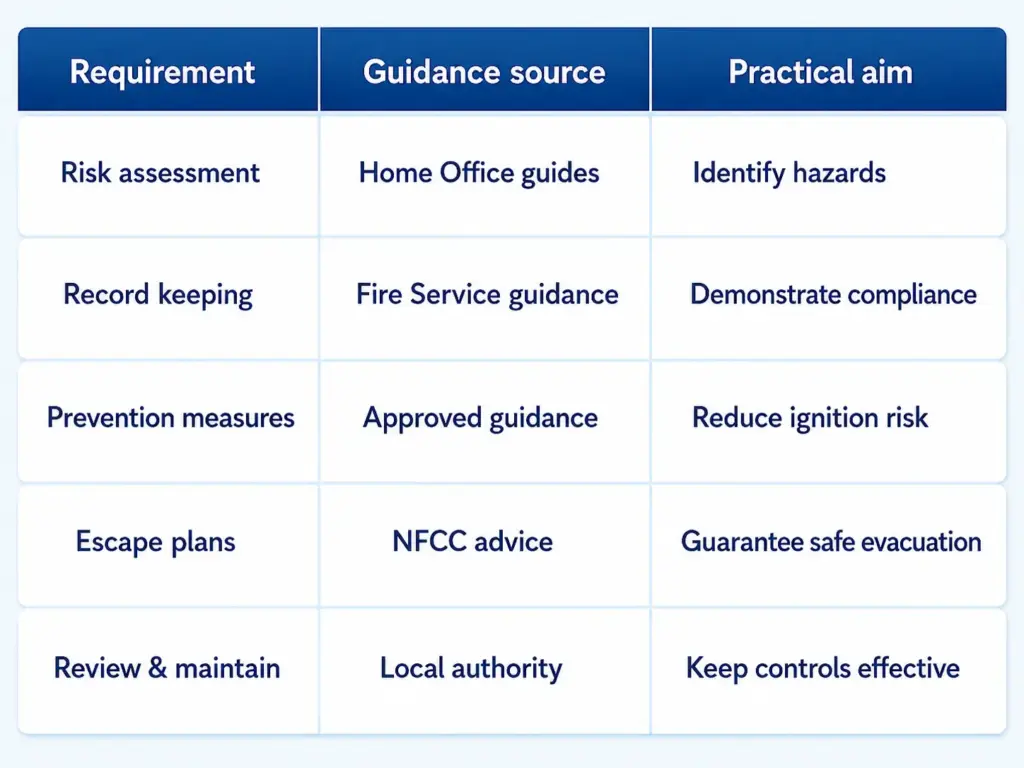
The Regulatory Reform (Fire Safety) Order 2005 (often called the Fire Safety Order) is the principal legislation governing fire safety in most non-domestic premises in England and Wales, placing a duty on the “responsible person” to carry out and record suitable and sufficient fire risk assessments, implement preventive and protective measures, and keep arrangements under review. It frames duties, enforcement powers, and expectations for proportionate, risk-based action. Official guidance (including the Home Office guides and NFCC/FSEG advice) interprets requirements, advises on practical steps, and supports compliance without prescribing unnecessary constraints. The Order promotes clear accountability while allowing flexible solutions suited to each premises.
Exemptions & When Other Regimes Apply (Homes, HMOs, Flats, Construction)
When does the Fire Safety Order not apply or yield to other regimes? The Fire Safety Order primarily covers workplaces and common parts but does not always govern every residential scenario. Specific legal frameworks or duties can instead apply, shifting responsibility and assessment approach. Notable situations include:
- Houses in Multiple Occupation (HMOs): local housing authorities enforce fire safety standards alongside licensing conditions.
- Purpose-built flats and converted blocks: responsibility may fall to landlords, managing agents, or building owners under separate housing or leasehold obligations.
- Domestic single-family homes: generally outside the Order’s scope; residents retain personal responsibility except where communal systems are affected.
- Construction sites and temporary works: covered by building regulations, CDM regulations, and site-specific safety plans rather than the Order.
Freedom-minded readers should note that where regimes overlap, the stricter standard usually prevails; dutyholders must identify the applicable law and act accordingly to guarantee lawful, safe outcomes.
What a Compliant Fire Risk Assessment Must Cover (Required Elements Checklist)
Although scope and detail vary by premises type and risk, a compliant fire risk assessment must systematically identify fire hazards, determine who is at risk, evaluate existing fire protections and escape routes, record and prioritise remedial actions, and set a timetable for implementation and review. It should list ignition sources, combustible materials, and activities that increase risk; map occupants and vulnerable groups, including visitors and contractors; and appraise detection, alarm and suppression systems, emergency lighting, signage, and fire doors. Escape route adequacy, capacity, and maintenance must be assessed alongside evacuation procedures and assembly points.
Responsibilities for fire safety management, training records, and communication arrangements are required. The document must note legal compliance gaps, provide a clear, proportionate action plan with timescales, and state review triggers. Evidence such as plans, photographs and test logs strengthens defensibility. The tone should enable responsible owners and managers to act decisively, protect liberty of occupants, and demonstrate due diligence to regulators.
How Often to Review and Update a Fire Risk Assessment
Having established what a compliant fire risk assessment must include, attention turns to how frequently it should be reviewed and updated to remain effective. Reviews should be pragmatic: a formal review at least annually is standard, with interim updates whenever circumstances change. Records must reflect review dates and actions taken, preserving clarity and accountability.
Practical triggers for revisiting an assessment include:
- major changes to layout, occupancy, or use that alter escape routes and hazards;
- incidents, near misses, or evidence that controls are failing;
- introduction of new processes, equipment, or significant renovation work.
A flexible, rights-respecting approach empowers responsible persons to act without delay. Routine reviews keep freedom of operation by preventing unexpected closures or enforcement action. Where uncertainty exists, conservative judgment is advised: treat any doubt as a prompt to reassess. Clear documentation and prompt updates maintain legal compliance and operational continuity while minimising disruption. Check out the details of How Often a Fire Risk Assessment should be Done?
When to Hire a Competent Assessor vs Do It Yourself
Who should carry out a fire risk assessment depends on the complexity of the premises, the competence available within the organisation, and the consequences of getting it wrong. For simple, low-risk settings small offices, single-floor shops, or domestic-style HMOs trained internal staff can undertake assessments if they have clear guidance, time, and impartiality. This route preserves control and flexibility for those valuing autonomy.
When buildings are large, multi-occupancy, host vulnerable people, or contain significant combustible processes, external competent assessors are advisable. Specialists reduce legal and safety exposure, bring up-to-date knowledge of regulations, and provide objective judgments that internal teams may lack. Commissioning a professional suits organisations that prioritise robust evidence and legal defensibility over DIY savings.
Delegation decisions should balance cost, independence, and the organisation’s appetite for risk. Regardless of choice, responsibility remains with the dutyholder to ascertain that assessments are effective, documented, and acted upon.
Practical Checklist: Get and Keep a Compliant Fire Risk Assessment
Before commissioning or updating a fire risk assessment, the dutyholder should follow a concise, practical checklist that guarantees the assessment is competent, evidence-based, and maintained over time. The dutyholder verifies legal status, chooses a qualified assessor, and defines the scope and frequency aligned with use and change. Documentation must record findings, actions, and responsible persons; reviews occur after alterations, incidents, or annually if risk dictates. Emphasis rests on proportionate measures that preserve occupant freedom while securing safety.
- Visualise a clear report folder, dated actions, and signatures authorising change.
- Imagine unobstructed escape routes, tested alarms, and records of drills guiding behaviour.
- Picture competent assessors checking records, interviewing staff, and confirming compliance.
Retention, transparent communication, and prompt remedial action keep assessments live. The dutyholder balances minimal intrusion with effective controls, ensuring lawful, resilient arrangements that protect people and support operational liberty.
Frequently Asked Questions
Can Tenants Request a Copy of the Building’s Fire Risk Assessment?
Yes. Tenants can request a copy of the building’s fire risk assessment; landlords or responsible persons should provide accessible information, respecting tenants’ autonomy while balancing confidentiality, safety concerns, and lawful redaction of sensitive details.
Are Landlords Fined if Tenants Alter Fire Safety Measures?
Yes. Landlords can face fines and prosecution if tenants’ alterations create fire hazards and landlords fail to enforce safety or remedy risks; penalties vary by offence, severity, and enforcement discretion, though responsibilities and liabilities can be contested.
Do Insurance Companies Require Specific Fire Risk Assessment Formats?
Yes; insurers often insist on particular fire risk assessment formats or accredited providers to validate coverage. The policyholder is advised to comply while retaining autonomy by choosing approved assessors and documenting conformity with the insurer’s specified criteria and standards.
How Does Brexit Affect Fire Safety Legislation Applicability?
Brexit did not remove domestic fire safety duties; the UK retains and adapts retained EU-derived rules and its own regulations. Legal obligations remain regionally devolved, with divergence possible over time as Westminster and devolved governments amend laws.
Are Electronic Signatures Valid on Fire Risk Assessment Documents?
Yes. They accept electronic signatures if they reliably identify the signer and indicate intent; compliance depends on auditability, tamper-evidence, and admissibility under UK law. The assessor prefers secure, verifiable digital signing methods.
Conclusion
In the UK, fire risk assessments are legally required for most workplaces and premises under the Regulatory Reform (Fire Safety) Order 2005, placing responsibility on the person in control to identify hazards, assess risks, and implement measures. Certain domestic premises and specific regimes may be exempt or subject to other rules. Assessments must be thorough, kept up to date, and reviewed after changes or incidents. Competent assessors are advisable for complex sites, with documented records retained as evidence of compliance.