



In the UK, PAT testing is not a legal requirement by name, but the law does require electrical equipment to be maintained in a safe condition. Employers and landlords must show they manage electrical risks responsibly. PAT testing is a widely accepted way to demonstrate this, especially in higher‑risk or public environments, and is often required for insurance compliance. A risk-based mix of visual checks and PAT testing is usually best, and the nuances become clearer as the topic unfolds.
Key Takeaways
- No UK law specifically requires “PAT testing”; instead, regulations demand that electrical equipment is maintained safely and does not pose a danger.
- Employers and landlords must show due diligence in keeping appliances safe, often using PAT testing as clear evidence of proper maintenance.
- PAT testing becomes practically essential in higher-risk or public environments, and where insurers or contracts explicitly require documented electrical safety checks.
- A risk-based approach is expected: some items need frequent PAT testing, others may only require periodic visual inspections and basic checks.
- Good documentation of risk assessments, test results, and corrective actions is crucial for demonstrating legal compliance and defending against claims or enforcement actions.
What UK Law Actually Says About PAT Testing
Surprisingly, for many duty holders, no specific UK statute explicitly requires “PAT testing” by name, yet several key regulations impose a clear legal duty to ensure electrical equipment is safe. The law focuses on outcomes, safe systems, safe kit, and protection from electric shock or fire rather than mandating a particular testing ritual or frequency.
Legislation such as the Health and Safety at Work etc. The 1974 Act and the Electricity at Work Regulations 1989 require that electrical equipment be maintained so it does not put people at risk. However, they leave the method open. This flexibility allows businesses and individuals to choose proportionate, risk‑based approaches rather than submit to one-size-fits-all schedules.
PAT testing consequently emerges as a commonly adopted method rather than a statutory command. In practice, the law demands evidence of sensible precautions and ongoing maintenance, while leaving room for choice in how that safety is demonstrated.
Legal Duties Around PAT Testing for Employers and Landlords
For employers and landlords, legal duties around PAT testing arise from broader obligations to provide and maintain safe electrical equipment for employees, tenants, and members of the public. The law focuses on outcomes: preventing electrical danger, demonstrating due diligence, and respecting people’s right to live and work without avoidable risk.
In practice, electrical safety duties usually include:
- Risk assessment – identifying which appliances, environments, and patterns of use create higher risk, rather than blindly testing everything on a fixed schedule.
- Maintenance systems – putting in place proportionate procedures such as visual checks, record‑keeping, and, where appropriate, formal PAT tests.
- Competence – ensuring anyone inspecting or testing equipment has suitable knowledge, equipment, and authority to act on unsafe findings.
- Documentation – keeping evidence of assessments, actions, and test results to show that risks are actively managed, not ignored.
These duties aim to balance safety with practical freedom, avoiding unnecessary bureaucracy. Learn more in detail PAT Testing for Landlords – Electrical Safety Compliance UK.
Do You Legally Need PAT Testing?
These general duties naturally raise the practical question of whether PAT testing itself is legally required. In UK law, no Act or Regulation explicitly states that “Portable Appliance Testing” must be carried out, nor that it must follow a fixed timetable such as “annually.” Instead, the law demands that electrical equipment be kept safe, and leaves people free to decide how they meet that standard.
Because of this, PAT testing is best understood as a recognised method of demonstrating that equipment is reasonably safe, not as a compulsory ritual. An organisation might rely on a mix of user checks, formal inspections, maintenance records, and selective PAT testing, tailored to the actual risks. Courts and regulators typically look for evidence of a thoughtful, proportionate approach, rather than blind obedience to a blanket testing rule. The legal obligation is safety; PAT testing is one potential route, not the law itself.
When PAT Testing Is Essential for Compliance
In practice, PAT testing becomes essential wherever it is the most reliable and defensible way to prove compliance with electrical safety duties. While no statute demands it by name, regulators, insurers, and courts often expect evidence at least as rigorous as a PAT regime. Where a duty holder wants maximum operational freedom with minimum legal risk, structured testing provides a clear paper trail.
PAT testing tends to be effectively indispensable when:
- Regulators are active – HSE inspections, licensing regimes, or sector‑specific rules expect demonstrable electrical maintenance.
- Public access is broad – venues, co‑working spaces, or events where many unrelated people use equipment.
- Insurance terms require it – policies that condition coverage on documented electrical safety checks.
- High‑risk environments exist – construction, industrial, or damp locations where failure consequences are serious.
In these scenarios, PAT testing underpins both legal defensibility and operational autonomy.
Which Appliances Typically Need PAT Testing
Appliances that typically require PAT testing are any portable or movable electrical items that could reasonably be expected to be used by employees, customers, or the public and that plug into a power source. This includes everyday office equipment such as computers, monitors, printers, extension leads, phone chargers, and desk lamps, as well as kettles, microwaves, fridges, and toasters in shared kitchens.
In workshops and industrial spaces, power tools, battery chargers, portable heaters, and site lighting usually fall within scope. In hospitality or retail environments, PAT testing normally covers display lighting, tills, card machines with plug‑in power supplies, sound systems, and any loaned or hired equipment.
Cables, plugs, and multi‑socket adaptors are often overlooked but are central to safety because they are handled frequently and easily damaged. You must know How Can PAT Testing Help in The Prevention of Fire Accidents?
Fixed wired installations are excluded; the focus remains on items that can be moved, unplugged, or relocated and are consequently more vulnerable.
How Often Should PAT Testing Be Done?
How often PAT testing should be carried out depends on the type of equipment, the environment it is used in, and the level of risk involved, rather than a single fixed interval set by law. Instead of blindly following a rigid timetable, a responsible duty holder uses judgement, evidence, and risk assessment to determine suitable frequencies.
A practical approach is to evaluate:
- Equipment type – Hand‑held or frequently moved items (extension leads, power tools) usually need more frequent testing than stationary, rarely moved appliances.
- Environment – Harsh, damp, or construction environments justify shorter intervals than clean, low‑risk offices or home‑style spaces.
- Usage and history – Heavily used items, or those with previous faults or damage, merit tighter retest cycles.
- Existing controls – Robust visual checks by staff and prompt reporting of damage may allow longer gaps between formal tests, provided risk remains demonstrably low.
This flexible model respects both safety and operational freedom.
Alternatives to PAT Testing (and Their Limits)
While some duty holders hope to rely solely on visual checks, user training, or smart plug technology, none of these options fully replace formal PAT testing when it comes to demonstrating electrical safety compliance. Visual inspections can reveal damaged cables, overheating, or obvious misuse, and they empower users to take immediate control over unsafe equipment. However, they cannot detect internal faults, deteriorating insulation, or incorrect earth continuity.
User training goes further, encouraging staff to unplug suspect appliances, recognise warning signs, and challenge unsafe practices. Yet, training depends on consistency, memory, and motivation; it offers no objective record that an appliance has been electrically verified.
Smart plugs and monitoring devices appeal to those seeking a low-friction, data‑driven approach. They can flag overloads, unusual consumption, or power loss. Still, they measure behaviour, not intrinsic electrical integrity, and consequently cannot provide the same level of assurance as instrument‑based PAT testing.

Proving PAT Compliance if Something Goes Wrong
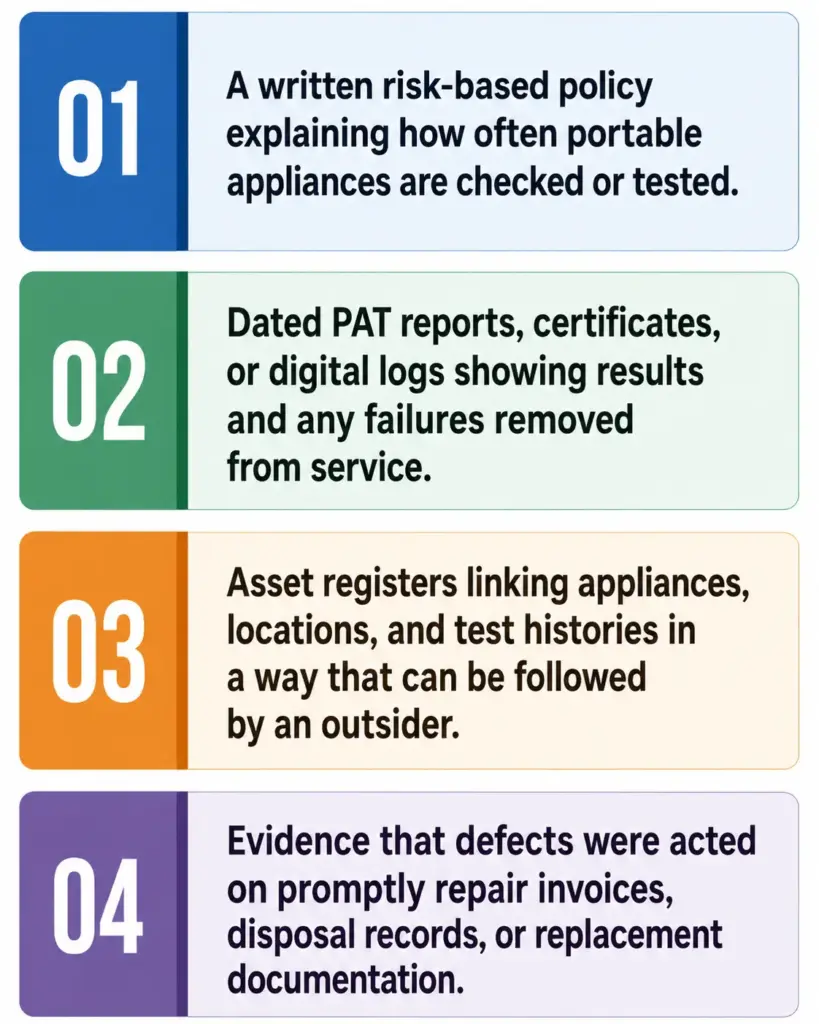
If a shock, fire, or near‑miss triggers an investigation, the focus quickly shifts from what went wrong to what can be proven about ongoing electrical safety management. Freedom from blame or prosecution often depends less on intention and more on evidence. PAT testing, while not always a strict legal requirement, becomes powerful proof that a duty‑holder took electrical safety seriously.
Investigators typically look for clear, traceable records that show a pattern of responsible behaviour, not one‑off gestures.
In practice, that means being able to demonstrate:
Choosing the Right PAT Testing Approach for Your Property
Evidence alone is not enough; it must be supported by a PAT regime that actually fits the property and its risks. Rather than defaulting to rigid annual testing, a responsible duty‑holder weighs how, where, and by whom each appliance is used. This risk‑based approach protects people without smothering them in unnecessary rules or expense.
The core questions are: how harsh is the environment, how vulnerable are the users, and how critical is the equipment? A home studio, a co‑working loft, and a licensed HMO may each justify very different intervals and test depths.
| Approach Type | When It Makes Sense |
| Minimal, risk‑based | Low‑risk homes, light office use |
| Standard commercial | Typical offices, shops, and co‑working spaces |
| Enhanced | HMOs, workshops, and venues with heavy public use |
| High‑intensity | Construction sites, industrial plants |
| Hybrid | Mixed‑use buildings with varied risk profiles |
The right choice balances liberty, safety, and budget.
Frequently Asked Questions
How Much Does PAT Testing Typically Cost for Small Businesses or Landlords?
PAT testing for small businesses or landlords typically costs around £1–£2 per item, with a minimum charge of £60–£100 per visit, depending on region, item volume, and contract flexibility.
Can I Do My Own PAT Testing Without Hiring an Electrician?
They can technically do their own PAT testing if they are competent, understand electrical safety, and use calibrated PAT equipment. However, training, accurate record‑keeping, and suitable insurance are essential, or they risk invalid cover and liability if something fails.
What Training or Qualifications Are Required to Perform PAT Testing Safely?
No specific formal qualification is legally required; however, the tester must be “competent.” This usually means practical PAT training, understanding electrical risks, equipment classes, test limits, safe isolation, and keeping records empowering independent, responsible testing.
How Can I Keep Digital Records and Labels for Pat-Tested Appliances?
They can log results in a spreadsheet or specialist PAT software, back up to cloud storage, and photograph labels. Generating unique IDs, QR codes, and date-coded stickers keeps appliances traceable while maintaining flexible, portable digital records.
Does PAT Testing Affect My Business Insurance Premiums or Coverage Terms?
PAT testing can influence business insurance by shaping both premiums and coverage terms. Insurers often reward clear testing records with smoother claims handling, potential discounts, and fewer restrictive conditions, supporting operational freedom and reduced disputes after electrical-related incidents.
Conclusion
In conclusion, PAT testing itself is not a strict legal requirement, but maintaining safe electrical equipment is. Employers and landlords must demonstrate they have taken reasonable steps to prevent electrical risks, and PAT testing is often the most practical way to do so. By evaluating risk, testing at appropriate intervals, keeping clear records, and choosing a proportionate approach, duty holders can help guarantee compliance, protect occupants, and reduce liability if an incident.