

The Gas Safety (Installation and Use) Regulations 1998 set mandatory duties and technical standards for safe installation, maintenance and use of gas appliances, flues and pipework across domestic, commercial and temporary premises in Great Britain. They define responsibilities for engineers, landlords, employers, and tenants; require competence, Gas Safe registration, ventilation, correct sizing, and accessible isolation valves; and mandate annual landlord checks with retained records. Practical compliance steps, enforcement risks, and documentation requirements are explained in more detail for those who want more detail.
Key Takeaways
- Sets legal duties for safe installation, maintenance, and use of gas appliances across domestic, commercial, and temporary premises.
- Requires competent, Gas Safe–registered engineers for installation, inspections, and remedial work.
- Mandates annual gas safety checks, accessible isolation valves, adequate ventilation, and correct flues for landlords.
- Duty-holders must keep inspection records for at least two years and act immediately on dangerous appliances.
- Non-compliance risks improvement notices, fines, prohibition of appliance use, and potential criminal prosecution.
Scope of the Gas Safety (Installation & Use) Regulations 1998
The Gas Safety (Installation and Use) Regulations 1998 define the legal framework governing the safe installation, maintenance, and use of gas appliances, fittings, and associated flues in Great Britain. The regulations apply to any premises where gas is supplied, covering domestic, commercial and temporary installations, and extend to new, modified or existing equipment. They set technical and procedural requirements: correct installation, proper ventilation, safe commissioning, periodic maintenance, and prompt fault repair. Exemptions are limited and specified; safety obligations follow the presence of a gas supply rather than ownership.
The scope includes appliances, meters, pipelines within the premises, and their flues, but excludes transmission networks and certain industrial processes governed elsewhere. Enforcement powers permit inspection and remedial action to protect occupants. The framework balances prescriptive duties with operational flexibility, enabling responsible parties to choose compliant methods while safeguarding freedom to manage premises without undue constraint. You must know the Difference Between Gas Safety Checks and Gas Appliance Services.

Who’s Legally Responsible: Engineers, Landlords, Employers
Responsibility for gas safety rests on distinct duty-holders whose legal obligations vary by role and context. Engineers hold competency and certification duties: they must work safely, follow standards, and issue certificates when required. Landlords have obligations regarding rented premises, ensuring that appliances and flues are safe and that records are maintained. Employers must protect employees from gas-related risks in the workplace by providing safe systems, training, and preventive measures. Each role balances legal accountability with practical freedom to choose compliant methods.
| Duty-holder | Core legal focus |
| Engineers | Competence, safe installation, certification |
| Landlords | Property safety, maintenance, record-keeping |
| Employers | Workplace safety, risk assessment, training |
| Tenants/Users | Report faults, allow access for safety checks |
Clarity in duty allocation preserves freedom by enabling informed choices and compliance pathways; duty-holders should document their actions and rely on competent professionals to meet legal expectations without unnecessary constraints.
Mandatory Gas Safety Duties and Required Checks
Several statutory duties require specific checks and documentation to guarantee gas safety across domestic and workplace settings. The Regulations oblige duty-holders to verify that appliances, flues, and pipework are safe, serviced, and inspected at prescribed intervals. Landlords and employers must commission competent, Gas Safe–registered engineers for installation, maintenance, and annual safety checks where applicable. Records of inspections, maintenance, and any remedial actions must be retained and made available to occupants or enforcing authorities for specified periods.
Gas Safety (Installation and Use) Regulations 1998: Immediate action is required when a gas appliance or installation presents a danger: isolation, notification, and urgent repair. Notification and reporting duties apply where safety defects are discovered, including issuing clear notices to relevant parties. Where certification or safety records exist, such as gas safety check records for rented premises, these must be supplied to tenants or kept on file. Compliance monitoring and documentation form the backbone of regulatory enforcement, aligning practical liberty with collective safety obligations. Learn more about When a Gas Safety Certificate Is Required and Why Compliance Matters.
Minimum Installation Standards for Appliances and Pipework
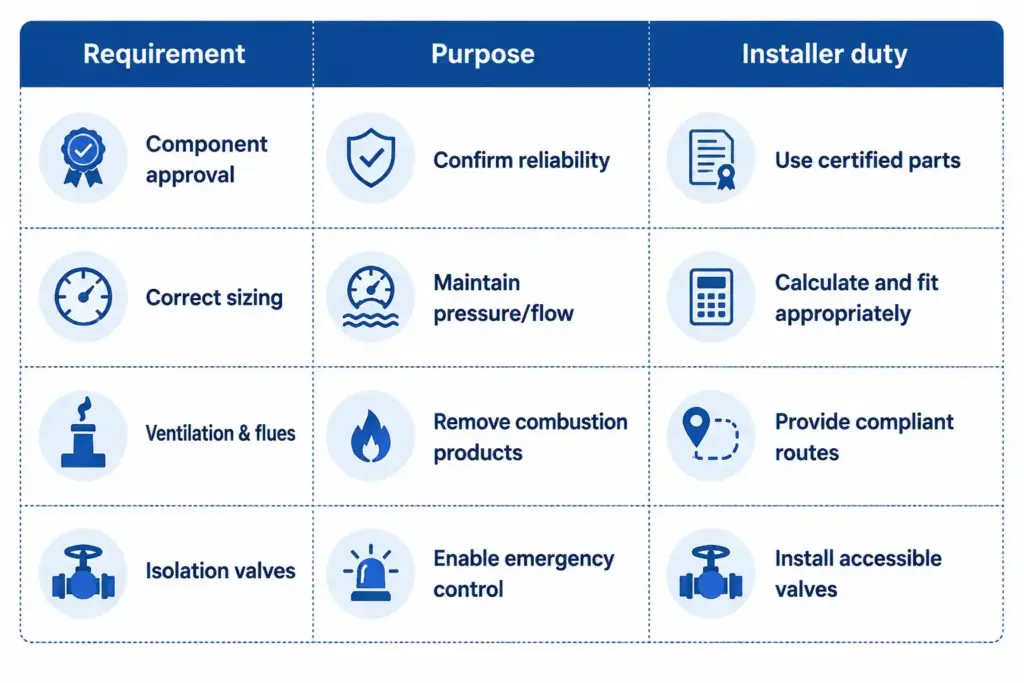
Minimum installation standards set clear technical and procedural requirements for gas appliances and pipework to guarantee safe, durable operation. The guidance mandates competent installers, approved components, correct sizing, secure joints, and adequate ventilation. Installations must prevent leaks, carbon monoxide ingress, and undue stress on fittings while allowing future servicing and modification without restriction.
Materials and methods should align with recognised codes to preserve occupant freedom to use premises safely. Spatial, clearance, and flue requirements ensure performance and emissions control; isolation and shut-off provisions enable immediate control. Certification on completion records conformance and enables lawful occupation. Enforcement focuses on objective compliance rather than preference, ensuring independent choices are informed by safety.
Ongoing Maintenance, Testing and Record-Keeping Requirements
Maintain regular maintenance, periodic testing, and thorough records to guarantee gas systems remain safe and compliant throughout their service life. The Regulations require owners and responsible persons to schedule preventive maintenance, perform functional and safety tests, and document all interventions. Competent engineers must carry out service work, test combustion, ventilation and safety devices, and promptly address defects. Records demonstrate conformity, support risk management, and provide occupants and operators with freedom from uncertainty.
- Routine maintenance: planned gas safety inspections, component replacement, and ventilation checks at manufacturer-recommended intervals by competent personnel.
- Periodic testing: safety appliance tests, flue and pressure tests, and leak detection using calibrated instruments, with failures remedied without delay.
- Record-keeping: retained service logs, test certificates, annotated repair notes, and dates of work and personal identities, held for specified retention periods to evidence ongoing compliance.
Documentation must be accurate, accessible, and auditable to preserve safety and operational autonomy.
Landlord Obligations: Annual Checks and the Gas Safety Certificate
When a property is let, the landlord must arrange an annual gas safety check for each appliance and flue, and obtain a Gas Safety Certificate (or equivalent record) confirming the inspection and any remedial work. This obligation ensures appliances are safe for tenants and provides a documented basis for compliance with statutory duties. The landlord is responsible for ensuring that checks occur within 12 months of installation or the previous check, and for promptly supplying tenants with a copy of the certificate.
Records must be retained for at least two years and produced on request to enforcing authorities. If defects are found, remedial action must be completed without undue delay to remove risk. Failure to comply exposes the landlord to enforcement action, fines, and potential criminal liability. The requirement supports tenant autonomy by establishing a predictable, transparent safety regime: occupants can rely on documented inspections, while landlords maintain clear evidence of compliance with regulatory expectations.

How to Choose and Verify a Competent Gas Safe Engineer
Having established the landlord’s duty to arrange annual gas safety checks and to act on any defects, attention turns to selecting the competent professional to perform those checks. The ideal Gas Safe engineer combines verified certification, relevant experience, and transparent communication. Verification begins with the Gas Safe Register: confirmation of identity, registration number, and scope of work must be obtained. References and recent work examples demonstrate competence with specific appliances and property types. Clear terms about access, turnaround, and reporting preserve tenant freedom and landlord control.
- Check the Gas Safe registration record number, expiry date, and permitted appliance types.
- Confirm relevant experience; ask for recent examples, references, and insurance details.
- Require clear reporting, a written certificate, recommended actions, and contactability.
How to Find a Reliable Gas Safe Registered Engineer Near Me? Choosing an engineer who is verifiable, communicative, and appropriately insured reduces risk and enables prompt, autonomous decision-making while fulfilling regulatory obligations.
Common Breaches, Enforcement Risks and a Practical Compliance Checklist
Inspectors commonly find failures that directly contravene duties under the Gas Safety (Installation and Use) Regulations 1998: missing or expired landlord gas safety certificates, unregistered or uncertified engineers carrying out work, inadequate records of appliance servicing, and ignored or unremedied safety defects. This section outlines typical breaches, potential enforcement actions, and a concise compliance checklist that enables responsible parties to act with autonomy and clear accountability. Enforcement ranges from improvement notices and fines to criminal prosecution and prohibition of appliance use. Proactive documentation, timely repairs, verified engineer certification, and transparent tenant communication reduce risk and preserve operational freedom.
| Common Breach | Practical Response |
| Missing certificate | Arrange inspection; issue record |
| Uncertified engineer | Verify Gas Safe ID; rework if needed |
| Poor records | Implement a central log system |
| Unresolved defects | Isolate the appliance; repair urgently |
| No tenant notice | Provide a safety leaflet and an access schedule |
Follow the checklist, document every step, and audit annually to maintain compliance and liberty.
Frequently Asked Questions
Do These Regulations Apply to LPG and Bottled Gas Systems?
Yes. The regulations apply to LPG and bottled gas when used as domestic or commercial fuel in fixed installations. They require competent installation, maintenance, and safety checks while respecting users’ autonomy and responsibility for safe operation.
How Do Regulations Interact With Building Regulations and Planning Permissions?
They operate alongside one another: gas safety regulations set technical and safety duties, building regulations enforce structural and installation standards, and planning permission controls land use; compliance with all applicable regimes remains the installer’s independent responsibility.
Do These Rules Cover Portable or Temporary Gas Heaters?
Yes, portable or temporary gas heaters are generally covered when used on premises, provided they are installed, maintained, and ventilated safely; responsibility lies with the occupier or owner to ensure compliance, though exceptions may apply in specific temporary scenarios.
What Are Penalties for Failing to Register With the Gas Safe Register?
Criminal prosecution, fines, and potential imprisonment can follow for failing to register with the Gas Safe Register; civil liability and reputational damage also arise, limiting professional freedom and risking business closure if noncompliance persists or causes harm.
Do Self-Installers Have Insurance Implications Under These Regulations?
Yes. A self-installer risks voided insurance and potential liability; insurers may refuse claims for unregistered, non-compliant work, leaving the individual personally responsible for damages, losses, and legal consequences without regulatory protection.
Conclusion
The Gas Safety (Installation & Use) Regulations 1998 set out clear duties for engineers, landlords and employers to ensure gas work is safe, properly installed and routinely maintained. Compliance requires competent, Gas Safe‑registered operatives, documented checks, and timely remedies for defects. Regular testing, record‑keeping and landlord annual inspections underpin tenant safety and legal protection. Failure to follow these standards risks enforcement action, liability and harm, making proactive adherence and thorough auditing essential for regulatory compliance.